
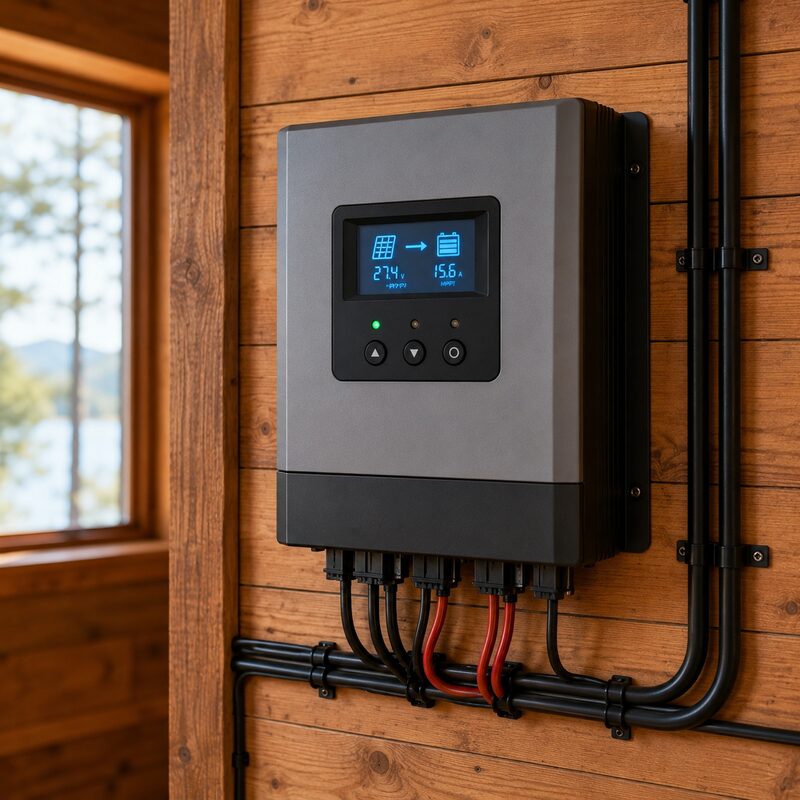
Best Solar Charge Controllers for Cabins (2026)

MPPT and PWM controllers ranked for off-grid cabins — the brain that protects your battery and squeezes the most from your panels.

The charge controller sits between your panels and your battery, regulating the charge so the bank fills safely and lasts. For most cabins an MPPT controller is worth it — it can pull 15–30% more energy from the same panels, especially in cold or cloudy conditions. Small starter setups can still save money with a simple PWM unit. Here are the best of both.

Our top pick: the Victron SmartSolar MPPT 100/30 — superb efficiency, built-in Bluetooth monitoring, and the kind of reliability that makes it a set-and-forget choice.

ControllerRatingTypePV MaxBest ForPrice
Victron SmartSolar 100/3030AMPPT100VMost cabins$$
Renogy Rover 40A40AMPPT100VValue$
EPEVER Tracer 4210AN40AMPPT100VBudget MPPT$
Victron SmartSolar 100/5050AMPPT100VLarger arrays$$$
Victron SmartSolar 150/3535AMPPT150VSeries strings$$$
Renogy Wanderer 30A30APWM25VSmall starters$
Reviews · 2026

The Best Cabin Charge Controllers, Ranked

Best Overall
100V/30A · MPPT

Victron SmartSolar MPPT 100/30

The controller most off-gridders end up recommending. Excellent MPPT efficiency, built-in Bluetooth for live monitoring and history right on your phone, and Victron's reputation for lasting for years without drama.

Rating
30A
Type
MPPT
PV Max
100V
Bluetooth
Built-in
  • High MPPT conversion efficiency
  • Built-in Bluetooth monitoring and history
  • Excellent low-temperature performance
  • Pairs with Victron's wider ecosystem
Best Value
40A · MPPT

Renogy Rover 40A MPPT

A proven, affordable MPPT controller that handles arrays up to ~520W at 12V. A clear LCD, broad battery-type support, and optional Bluetooth module make it a strong value backbone for most cabin systems.

Rating
40A
Type
MPPT
PV Max
100V
Display
LCD
  • Handles arrays up to ~520W (12V)
  • Clear on-unit LCD readout
  • Supports lithium and lead-acid profiles
  • Optional Bluetooth module available
Best Budget MPPT
40A · MPPT

EPEVER Tracer 4210AN 40A

EPEVER's Tracer series delivers genuine MPPT performance at a budget price, which is why it's a DIY favorite. Add the optional meter for full monitoring and you have a capable controller for very little money.

Rating
40A
Type
MPPT
PV Max
100V
Cost
Low
  • Real MPPT tracking at a low price
  • Configurable for multiple battery types
  • Optional remote meter for monitoring
  • Reliable DIY-community favorite
Best High-Power
100V/50A · MPPT

Victron SmartSolar MPPT 100/50

For larger arrays, the 100/50 handles up to ~700W at 12V (more at 24V) with the same Victron efficiency, Bluetooth, and reliability as the 100/30 — the controller to grow into for a bigger cabin.

Rating
50A
Type
MPPT
PV Max
100V
Bluetooth
Built-in
  • Headroom for larger cabin arrays
  • High efficiency and cold-weather output
  • Built-in Bluetooth monitoring
  • Scales with 12V or 24V systems
Best High Voltage
150V/35A · MPPT

Victron SmartSolar MPPT 150/35

A 150V PV input lets you wire panels in series for longer, thinner, cheaper wire runs — handy when the array sits well away from the cabin. Same trusted Victron platform, built for higher-voltage strings.

Rating
35A
Type
MPPT
PV Max
150V
Wiring
Series-friendly
  • 150V input suits series panel strings
  • Longer runs on thinner, cheaper wire
  • Great for ground mounts away from the cabin
  • Bluetooth monitoring built in
Best Budget PWM
30A · PWM

Renogy Wanderer 30A PWM

For a small 100–200W starter setup, a PWM controller like the Wanderer keeps things simple and cheap. It's the right tool when the cost of MPPT outweighs the modest efficiency gain at small scale.

Rating
30A
Type
PWM
PV Max
25V
Cost
Very low
  • Inexpensive and simple to wire
  • Fine for small 100–200W arrays
  • Negative-ground design
  • Compact and reliable for starters
Questions

Charge Controller FAQs

MPPT vs PWM — which charge controller should I get?
MPPT for almost any cabin array of 200W or more — it harvests 15–30% more energy, especially in cold or low light, and supports higher panel voltages. PWM is cheaper and fine for small 100–200W starter setups where the efficiency gain doesn't justify the cost.
What size (amps) charge controller do I need?
Divide your array wattage by your battery voltage, then add ~25% headroom. For example, a 400W array on a 12V bank is ~33A, so a 40A controller fits. Always size up if you plan to expand the array later.
Can one controller handle my whole array?
Up to its amp and voltage limits, yes. Check both the maximum charge current (amps) and the maximum PV input voltage against your array. Larger systems sometimes use multiple controllers or a higher system voltage (24V/48V) to stay within limits.
Does the controller need to match my battery type?
It should support it. Quality controllers let you select lithium (LiFePO4), AGM, gel, or flooded profiles so the charge voltages are correct. Using the wrong profile can undercharge or damage your bank — set it to match your battery.

Affiliate Disclosure: SolarCabin.co is reader-supported. When you buy through links on our site, we may earn an affiliate commission at no additional cost to you. As an Amazon Associate and eBay Partner, we earn from qualifying purchases. We only recommend products we genuinely believe in, and we never invent specs or reviews.